
AI usually isn't the problem. It just doesn't know your business.
Most small businesses have already tried AI. Someone on the team uses ChatGPT or Claude to write an email, summarize a document, or brainstorm a post. It helps a little. Then it stalls.
I hear the same thing from owners over and over: "It's fine for first drafts, but I end up rewriting everything." The tempting conclusion is that the AI isn't good enough yet. In my experience, that's almost never the problem.
The problem is that the AI doesn't know anything about your business. It doesn't know your clients, your prices, how you onboard a new customer, what you promised in last Tuesday's meeting, or how you like things worded. So it guesses. And you spend the time you saved fixing its guesses.
I call that the context gap.
Same AI, same prompt, different answer
Here's the clearest way I know to show it. Take one request: "Draft a reply to this customer asking about a spring cleanup."
Without context, the AI writes a polite, generic email. It invents a price, gives a vague timeline, and uses a tone that doesn't sound like you. You rewrite most of it.
With context, the same AI can read your services page, your current price sheet, your scheduling rules, and this customer's history. It drafts a reply that quotes the right package, offers two real open dates, and mentions last year's job. You review it and send.
Same AI. Same prompt. The only difference is what it had to stand on.
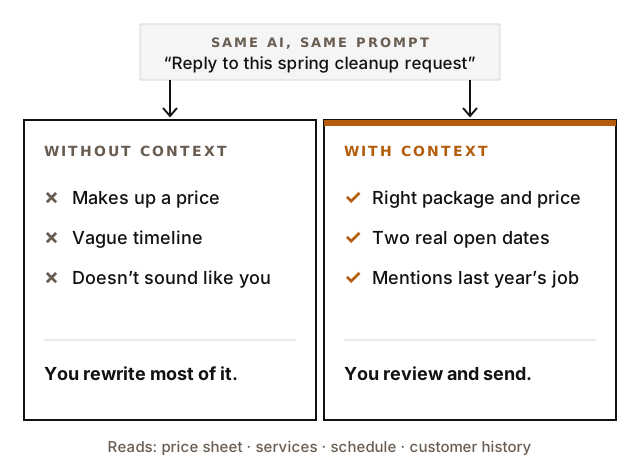
Same AI, same prompt. The only difference is what it could read about your business.
Why this matters more every month
AI is moving from answering questions to doing work. Agents can look things up, follow steps, and take action: draft a reply, update a record, create a task. That's useful, but it raises the stakes. A chatbot that guesses wastes a few minutes. An agent that guesses sends the wrong price to a customer.
I spent about eight years as a Salesforce developer and administrator, building and cleaning up the systems companies rely on to know who their customers are. The biggest lesson from that work carries straight over to AI: a system is only as useful as the information inside it. Messy, scattered, out-of-date information gives you confident nonsense. Clean, organized, current information gives you real help.
AI amplifies whatever you give it. Feed it chaos and you get faster chaos.
What "grounding" means
Grounding means connecting AI to trusted, specific information about your business, so its answers and actions are anchored in what's actually true. It's why I named my company GroundWise.
In practice, it comes down to a few things most businesses can do without a developer:
- One page that describes your business. Who you serve, what you sell, current prices, how you talk, and your hard rules. I call it a Company Profile page, and it's the highest-return hour you can spend.
- One official home for each kind of information. Clients in your CRM, money in your accounting system, how-we-work docs in one hub. Not everything in one tool, just one clear home per type.
- Information that's current. An owner and a review date on every important page. Out-of-date information is the most common cause of wrong answers.
- A person in the loop. AI drafts; people approve. You hand over more as trust grows.
Order matters
Most businesses jump straight to the agent. They buy a tool, turn it on, and are disappointed. The order that works is the opposite: ground first, then automate. Organize the information, connect your AI to it, let it do one real job, and measure what it saves.
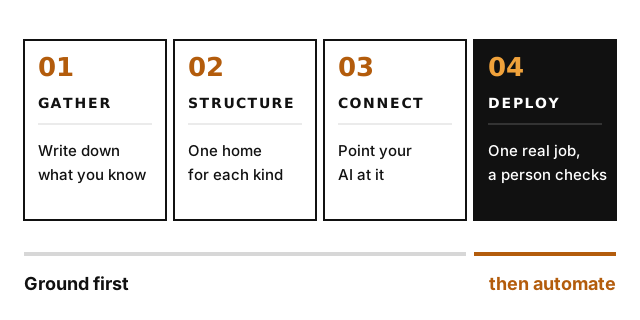
Three steps of grounding come before the first bit of automation.
The first step is small. You don't need a data team or a big budget. You need an afternoon, a blank page, and the willingness to write down what's currently in your head.
Try this today
Pick the request your business gets most often. Ask your AI tool to answer it with no context. Then paste in your price sheet and two emails you were proud of, and ask again. Compare the two answers. That difference is your context gap, and it's the clearest to-do list you'll ever get.
Get the free guide. Grounded: Your first steps to an agent-ready business walks through a 30-day plan to close the context gap, with templates and quick wins. Download the free Grounded guide.